Gray Wolf Facts
Physical Characteristics
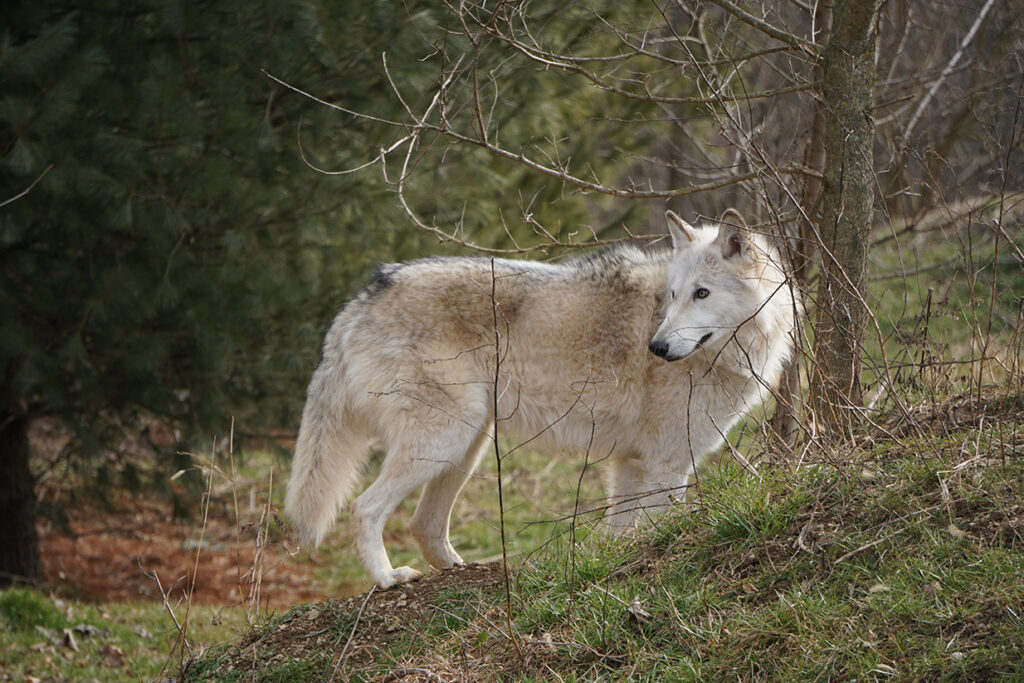
On average, female gray wolves weigh between 55 and 100 pounds, and male gray wolves weigh between 70 and 145 pounds. The length of the gray wolf varies between 4’6″ and 6’6″ from muzzle to tip of tail. The height of an average gray wolf is between 26 and 32 inches at the shoulder.
Wolves have large paws, the average being 4 inches wide by 5 inches long.
A gray wolf in a hurry can run as fast as 35 miles per hour for short distances.
Fur color varies from gray, tan and brown to pure white or black.
Wolves have 42 teeth. A wolf’s jaw can exert 1500 pounds of pressure per square inch when using their back carnassial teeth, twice the jaw pressure of a German Shepherd. Wolves can crush large bones in just a few bites. Their front canines can be up to 2 inches in length.
Wolves’ hearing and smell are their strongest senses, while their eyesight is only about as good as humans. They have 280 million olfactory receptors in their nose (humans have about 5 million).
Wolves have many seasonal adaptations that enable them to survive. They love winter! Wolves can withstand up to negative 35 degrees F and they have many winter adaptations to allow them to do this. Blood vessels in their long legs are close together to allow blood flowing up from their paws to warm before it gets to their chest. Their thick under coat of fur keeps them warm and their slightly more coarse outer layer protects them from wind, rain, and snow. Their ears are coated with a dense layer of fur as well. Their metabolism allows them to eat ice for hydration in the winter without causing hypothermia.
Wolves can live up to 13 years in the wild but the average is only 6 to 8 years. Wolves in captivity have been known to live up to 16 years. Our eldest wolf at the sanctuary lived to be over 19 years old.
Pack Dynamics
Wolves are social animals and live in packs. Packs can have as little as 2 members or as many as 30 members. Average Pack size is 6 to 8. The pack is composed of the breeding pair and their offspring.
Gray wolves hunt in packs and primarily prey on large ungulate species including deer, moose, caribou, elk, and bison. They also have been known to prey on fish and beaver in some regions.
Wolves breed once a year, December through March, depending on latitude, the gestation period is 63 days.
Wolf pups are born in northern climates as late as early June and in southern climates as early as late February.The average litter size is 4 to 6 cubs.The cubs weigh approximately one pound at birth and cannot see or hear.
Communication
Wolves communicate in three major ways: vocalization, body language, and scent marking. Vocalizations include howling, growling, whimpering, whining, and barking. Body language includes eye contact, facial expressions, body movement, posture, and tail position. Scent marking includes urination as well as the use of scent glands present throughout different areas of their body.
Species and Subspecies
There are two species of wolves in North America – Gray wolves (Canis lupus) and Red wolves (Canis rufus). Red wolves are severely endangered, with only a few left in the wild. Of the Gray wolves, there are 4-5 subspecies, meaning within the same species (Canis lupus) but having physiological and/or behavioral differences, and usually in separate geographical regions. Arctic or tundra wolves are furthest north, usually the largest, typically white (though not always). Timberwolves are the subspecies that would have lived in PA one hundred years ago. They are sometimes split between Northern Timberwolves and Eastern Timberwolves. Great Plains subspecies are the current population in Yellowstone National Park. Mexican Gray wolves are severely endangered and only exist in some southwest states (ex. New Mexico, Arizona). They are often smaller and with reddish hues to their coat to adapt to the desert environment.
Coyotes are relatives of wolves, but a different species. The main physical difference is size. Coyotes, (Canis latrans) are much smaller, with shorter, more pointed snouts, narrower ears, and smaller paws. Coyotes can also breed more than once per year. Wolves and coyotes typically compete for territory. Northeastern coyotes (also called Eastern Coyotes), have been nicknamed the “coywolf” because of their larger size and because they replaced wolves in the ecosystem here.
Dogs are also relatives of wolves (Canis lupus familiaris). The major behavioral difference between a wolf and a dog is domestication, which often results in fear or lack of fear of humans. Dogs were selectively bred to be companions to humans. Wolves are not domesticated and instinctively fear humans. Wolves are also not receptive to training, though they rank higher than dogs on intelligence tests involving problem solving.
Wolves and dogs also have many physical differences. A few of physical characteristics that are consistent wolf traits are:
- straight tail
- two layers of fur including a soft dense underalyer and an outer layer that includes guard hairs
- paws facing slightly outward when standing indicative of a different gait when walking and running
- long, lean body
- long snout that can open wider to be able to grasp prey
- long canines that curve slightly inward
- wide ears densley packed with fur
- scent glands including a visible precaudal or supracaudal gland in the middle of the tail
- brown, orange, or golden eye color
Territory and Habitat
Wolves thrive in a variety of habitats including arctic tundra, taiga, deciduous forests, grasslands, and desert. Different species and subspecies have variations in their physical characteristics to help them to adapt to the biome where they live.
The range of a pack’s territory varies with location. In the Alaskan or Canadian wilderness the territory for one pack can range from 300 to 1,000 square miles while in the continental U.S. the territory can be as small as 50 square miles.
Loss of habitat and persecution by humans are the major threats to wolves in the wild. Historically, wolves once lived in every state in the US, except Hawaii. Due to overhunting and habitat destruction, their populations declined until they were locally extirpated from the continental US. In the 1970’s they were added to the Endangered Species List and in 1995 they were reintroducted to Yellowstone National Park. Since then their populations have recovered in many places including a large part of the Northwest and Great Lakes Region. Since their recovery, their endangered status has fluctuated over the past few decades, losing federal protections across some of their range in 2011, losing full federal protections in 2020, then regaining federal protections again in 2022. Their conservation status remains a point of contention, and there are still annual hunting bounties in areas where their populations have recovered.